
Is Off-the-Shelf Software Holding You Back?
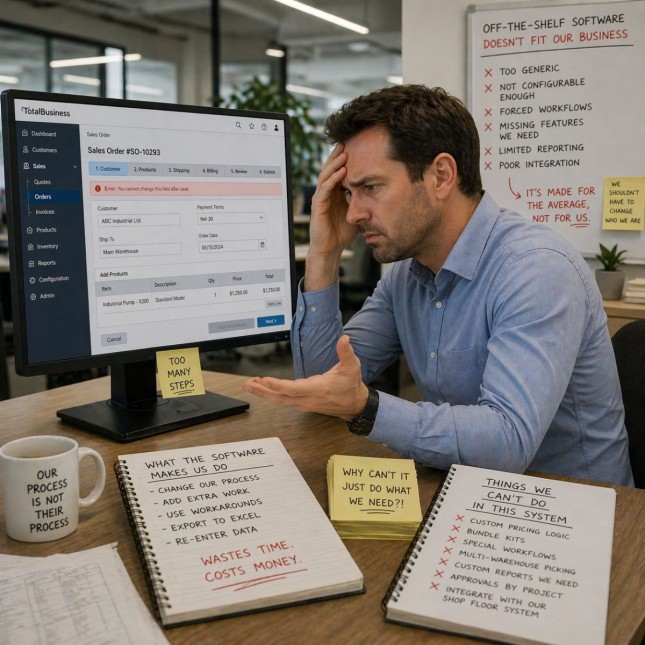
Off-the-shelf software is often the first step for growing businesses. It’s quick to implement, appears to be low cost, and designed to solve common challenges across a wide range of industries.
But as your business evolves, what once felt like a smart, efficient solution can start to create friction. The very tools that helped you get started may now be limiting how far—and how fast—you can go.
So how do you know if off-the-shelf software is holding you back?
When Your Processes Start Bending to Fit the Software
Off-the-shelf systems are built for the masses. That means they’re designed around standard workflows—not the unique way your business operates.
If you find yourself changing how your team works just to fit the system, it’s a warning sign. Over time, these compromises can reduce efficiency, create confusion, and dilute what makes your business effective in the first place.
Your software should support your processes—not dictate them.
Workarounds Are Becoming the Norm
A few workarounds here and there might seem harmless. But when they become part of everyday operations, they signal a deeper issue.
Common signs include:
- Exporting data to spreadsheets to “fix” it
- Manually re-entering information between systems
- Using multiple tools to complete a single task
These inefficiencies add up quickly—costing time, increasing errors, and frustrating your team.
Limited Flexibility as You Grow
Growth brings change: new services, new markets, new ways of working. Off-the-shelf software can struggle to keep up.
You may find that:
- Customisation options are limited or expensive
- New requirements can’t be supported at all
- Updates force changes you didn’t ask for
Instead of enabling growth, your software becomes a constraint—forcing you to work around its limitations rather than move forward freely.
Integration Challenges
Most businesses rely on multiple systems. When those systems don’t integrate well, problems start to surface:
- Data silos across departments
- Inconsistent or outdated information
- Time wasted switching between platforms
Off-the-shelf tools often offer only basic integrations, which may not fully meet your needs. As your tech stack grows, so does the complexity of keeping everything connected.
Paying for What You Don’t Use (and Missing What You Need)
Generic software often comes packed with features designed to appeal to a broad audience. The result? You may be paying for functionality you never use—while still lacking the specific capabilities your business actually needs.
This mismatch can lead to poor value over time, even if the initial cost seemed attractive.
Poor User Adoption
If your team finds the system difficult to use or misaligned with their daily tasks, adoption will suffer.
You might notice:
- Employees reverting to old methods
- Inconsistent usage across teams
- Increased training and support needs
When software doesn’t feel intuitive or relevant, it becomes a barrier rather than a tool.
Lack of Competitive Differentiation
Your processes are part of what sets you apart from competitors. But if you’re using the same tools as everyone else, it becomes harder to maintain that edge.
Off-the-shelf software encourages standardisation—which can be useful, but also limiting. It may prevent you from fully leveraging the unique ways your business creates value.
Hidden Long-Term Costs
While off-the-shelf solutions are often cheaper upfront, the long-term costs can add up:
- Subscription fees that increase over time
- Costs for add-ons or integrations
- Time lost to inefficiencies and manual work
What seems cost-effective at the start may become expensive as your reliance—and frustration—grows.
So, What’s the Alternative?
When off-the-shelf software starts to hold you back, it may be time to consider a different approach.
Bespoke software is designed specifically around your business processes, goals, and challenges. Instead of forcing your operations into a predefined structure, it adapts to you—supporting how you work today while remaining flexible for the future.
It can:
- Eliminate unnecessary workarounds
- Integrate seamlessly with your existing systems
- Scale alongside your business
- Provide exactly the functionality you need—no more, no less
Final Thoughts
Off-the-shelf software isn’t inherently bad—it plays an important role, especially in the early stages of a business.
But as your organisation grows, it’s worth asking whether your tools are still serving you—or slowing you down.
The right technology should enable progress, not restrict it. If your current systems are creating friction, limiting flexibility, or holding back your potential, it may be time to rethink your approach and explore solutions built around your business—not the other way around.
Recent Insights
Transforming your Business With Bespoke Software (eBook)
This eBook explains how growing businesses outgrow spreadsheets and off-the-shelf tools, and why bespoke software provides a scaleable, efficient solution aligned to their operations.
Find Out MoreUsing Spreadsheets to Run Your Business? What’s the Risk?
Spreadsheets are popular because they’re flexible, familiar, and work well for simple or early-stage business tasks. However, as a business grows, relying on them for core operations can create hidden risks—reducing accuracy, efficiency, and the quality of decision-making, and turning a once-helpful tool into a weak foundation.
Find Out MoreWhen Replacing Your Legacy Software Seems an Impossible Task
Many businesses outgrow their existing software, but replacing it feels daunting because it’s deeply embedded and shaped by years of changes. As a result, companies often tolerate inefficiencies rather than face disruption. In reality, though, replacing legacy systems is usually a gradual, structured process—not a sudden overhaul.
Find Out MoreHow Bespoke Software Aligns with Your Business Processes (and Doesn’t Fight Them)
Off-the-shelf software promises speed, affordability, and convenience. But as many organisations discover, it often comes with a hidden cost: compromise.
Find Out MoreInnovative technology that’s worth your investment
Whatever the size or complexity of your business, we can design a software solution to help drive efficiency improvements.