
How Mobile Apps Can Transform Field Service Operations
For businesses with engineers working at customer sites, coordinating jobs involves much more than allocating work. Office staff need to know what is happening, engineers need the right information, and customers want to be kept informed.
Many businesses manage this through a mixture of spreadsheets, telephone calls, emails, paper job sheets and WhatsApp messages. These methods can work well initially, but as workloads grow, keeping everything organised becomes increasingly difficult.
An integrated job management system and mobile app can bring these activities together, giving office staff and engineers access to the information they need.
Giving Engineers the Right Information
An engineer arriving on site without clear instructions, the correct documents or details of previous work can lose valuable time before the job has even started.
Information may be spread across emails, paper files and conversations with different members of the office team. Changes made after a job was allocated may not reach the engineer at all.
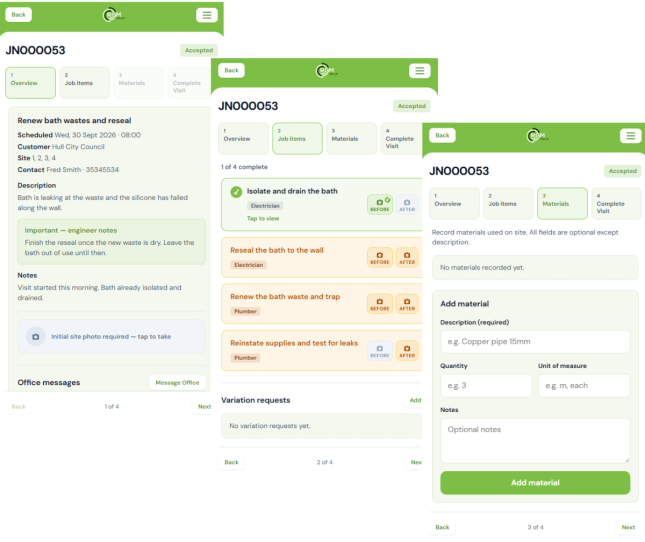
A mobile app can give engineers access to their assigned jobs on a phone or tablet, including:
-
Customer details, site addresses and contact information.
-
Job descriptions and individual tasks.
-
Appointment times and access instructions.
-
Plans, drawings and supporting documents.
-
Relevant photographs and previous job history.
Having this information available in one place helps engineers prepare for the work and reduces the need to call the office for clarification.
Making Scheduling Easier to Manage
Planning work becomes more complicated as the number of jobs and engineers increases.
Office staff may need to consider availability, skills, location, holidays and the expected duration of each job. An urgent call or an appointment that overruns can affect the rest of the schedule.
A central scheduling system makes it easier to see who is available, allocate work and identify gaps or conflicting commitments.
When schedules change, updated assignments can be made available to engineers through the app, helping everyone work from the same plan.
Seeing Progress Without Chasing Updates
Without a connected system, office staff often rely on telephone calls or messages to find out whether an engineer has arrived, started work or completed a job.
This interrupts both teams and can leave the office working with incomplete or outdated information.
Through an integrated app, engineers can update job status, record work completed and flag issues directly against the job. These updates become available to the office team, helping them respond to customer enquiries and coordinate the next steps.
Instead of piecing together separate conversations, staff can see a clearer picture of progress across the business.
Keeping Photographs and Documents with the Job
Photographs are often essential for recording site conditions, demonstrating completed work or highlighting a problem.
However, images sent through WhatsApp or email can become difficult to trace. Staff may have to search through conversations, work out which job a photograph relates to or ask an engineer to send it again.
A mobile app allows photographs and notes to be uploaded directly to the relevant job.
Before and after images, supporting documents and customer signatures can be kept together, creating a record that is easier to find and refer to later.
Reducing Paperwork and Repeated Data Entry
Paper job sheets can create work long after the engineer has left the site.
Someone may need to interpret handwritten notes, enter details into another system, check missing information and chase paperwork before the job can be closed.
Recording information through an app allows engineers to complete relevant details while they are on site. This could include:
-
Work carried out and tasks completed.
-
Time spent and materials used.
-
Inspection results or checklist responses.
-
Follow-up work required.
-
Customer confirmation and signatures.
Capturing information once reduces the need to retype it and helps office staff receive more complete, consistent records.
Helping Jobs Move Through to Invoicing
Completing the physical work does not always mean a job is ready to invoice.
Missing job sheets, unrecorded materials or unanswered questions can delay the process. These delays create additional administration and can affect cash flow.
An integrated system can help identify completed jobs, highlight outstanding information and make the details needed for invoicing available to the office team.
Where appropriate, integration with accounting software can also reduce repeated entry between systems.
Improving the Customer Experience
Customers benefit when your team has accurate information and a clear understanding of what is happening.
Office staff can answer progress enquiries more confidently. Engineers arrive with better instructions and relevant job history. Issues identified on site can be passed back promptly so that action can be agreed.
Together, these improvements support a more organised and responsive service.
Designing the System Around Your Business
Field service businesses do not all work in the same way.
An installation company may need drawings and progress photographs. A maintenance business may need equipment histories and recurring visits. An inspection team may need structured checklists and detailed reports.
At Intradev, we work with clients to understand these requirements and develop integrated job management systems and mobile apps around their processes.
The office system and engineer app work together, connecting customer records, jobs, scheduling, documents and updates. We also consider practical requirements such as the devices engineers use and the availability of a mobile connection at customer sites.
The aim is to make everyday work easier for both the office and the field team, while giving the business better visibility and a foundation for growth.
If your team spends too much time chasing updates, finding photographs or processing job paperwork, contact Intradev to discuss how an integrated system could help.
Recent Insights
Transforming your Business With Bespoke Software (eBook)
This eBook explains how growing businesses outgrow spreadsheets and off-the-shelf tools, and why bespoke software provides a scaleable, efficient solution aligned to their operations.
Find Out MoreUsing Spreadsheets to Run Your Business? What’s the Risk?
Spreadsheets are popular because they’re flexible, familiar, and work well for simple or early-stage business tasks. However, as a business grows, relying on them for core operations can create hidden risks—reducing accuracy, efficiency, and the quality of decision-making, and turning a once-helpful tool into a weak foundation.
Find Out MoreIs Off-the-Shelf Software Holding You Back?
Off-the-shelf software is a practical starting point for growing businesses due to its ease, cost-effectiveness, and broad functionality. However, as a business evolves, these tools can become restrictive, creating friction and limiting further growth.
Find Out MoreWhen Replacing Your Legacy Software Seems an Impossible Task
Many businesses outgrow their existing software, but replacing it feels daunting because it’s deeply embedded and shaped by years of changes. As a result, companies often tolerate inefficiencies rather than face disruption. In reality, though, replacing legacy systems is usually a gradual, structured process—not a sudden overhaul.
Find Out MoreIs Your Microsoft Access System Struggling to Keep Up with Your Business
Discover how Intradev can support your existing Microsoft Access system while helping you move to a modern browser-based solution that meets your business needs.
Find Out MoreInnovative technology that’s worth your investment
Whatever the size or complexity of your business, we can design a software solution to help drive efficiency improvements.